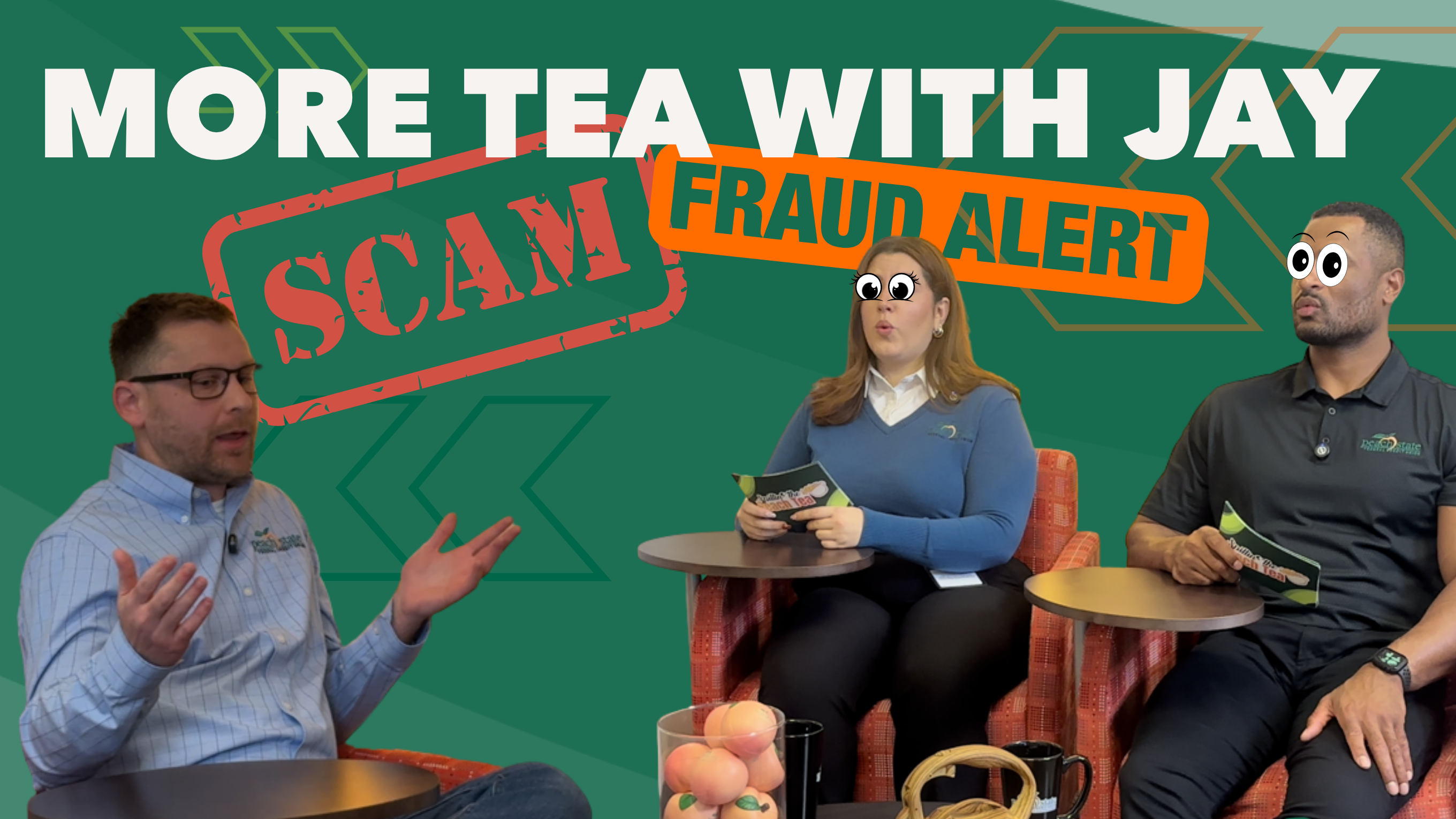
In this episode we'll be sitting down with Jay Gilling, our VP of Fraud and Loss Prevention. We'll be discussing the differences between financial fraud and scams and giving you guys tips on how to protect yourself and your loved ones!
Video Transcription Below:
00:12
Hello and welcome to the first episode of Spilling the Peach Tea. My name is Gabe.
And my name is Elia and today we're going to be discussing the differences between financial fraud and scams and how to protect yourself and your loved ones.
We're joined by a very special guest, Jay Gilling from our fraud department here at Peach State. How are you doing, Jay?
Great. Excited to be with you both today.
Awesome, awesome. So, Jay, can you tell the audience a little about what you do here?
00:36
Yep. So I'm Jay Gilling, Vice President of Fraud and Loss Prevention with Peach State. Been here almost three years now. And me and my team, we handle fraud from deposit fraud, fraudulent loan applications, identity theft, you name it, if it's trying to steal from our members or the credit union, I want to know about it and fix it.
1:05
So we hear a lot about financial fraud and scams, and sometimes the terms are used interchangeably. Can you explain the differences between both?
So fraud is a crime where somebody is trying to take your money, and you're not aware. You don't have to be a part of it. Somebody's trying to take something, for example, you wrote a check, you dropped it in the mail, somebody stole it, they changed the name on the payee, and you realize that check you made to Georgia Power has now cleared to a guy you don't know. That's fraud. Checking your bank statement, you see a debit to a company you've never heard of, that's fraud.
1:49
A scam is you're losing money, you're involved because somebody looped you in and you played a role either knowingly or unknowingly. You gave out your online banking credentials to somebody because they tricked you into thinking they were with Amazon, they were with a fake Peach State fraud department. You know, basically I look at it like that fraudster had some information about you. They had some of the keys to the kingdom, but they didn't have everything until you gave them that last little piece because you were tricked into doing it.
2:30
So I know that, again, you just hit on those examples. Who's most likely to fall for a scam? Is there a common trend between a scam and like falling for a scam and fraud?
So true fraud, anybody can fall victim to. I mean, that involves not a lot of your input. That's if you're mailing checks, if you're kind of careless putting your information on the internet, social media, websites that are sketchy, that kind of thing, you've got a higher chance of falling victim to fraud. So there's no age range, anything like that.
Scams, they tend to kind of horseshoe. I see a lot more younger folks and a lot more of our seniors. In the middle, people who can still fall victim to fraud, to scams, but those are the two demographics that we see peak.
3:34
For more tips on how to stay safe online, here's a reel from our socials.
October is Cybersecurity Awareness Month. And in honor of this, we're going to be talking to a member of our fraud team to help you get the answers you need to keep you safe. Let's go.
Hey, I'm Jay, how can I help you?
What's one smart habit to keep your money safe online?
The number one thing you can do online is make sure you're on the actual website that you're searching out. There's a lot of counterfeit sites that pop up when you search with search engines. So just make sure even though you're at the top of the list that popped up, that you're on that actual site before you put your info in.
If you're not already doing so, follow us on Facebook, Instagram, LinkedIn, and Twitter to see more important information, fun content, and to stay up to date on everything Peach State.
4:37
Have you come across any fraud stories that you can talk about, anything that's stuck with you, out of the norm?
Fraud is one of those things that, you know, it's all awful to deal with, but we definitely have seen some crazy stuff. At previous institutions, I've had people fall victim to romance scams where their girlfriend, they're absolutely certain that that's them, and it's been people from Jennifer Aniston to Brad Pitt.
Which is ironic because why don't those two just get together, have they thought of that. Alan Jackson, I mean, you name it. So you really have to break it down. Fraud, I mean, I've seen some truly talented fraudsters, if you want to give them credit.
5:37
Using AI, using voices, video, building fake websites, having the patience to build these elaborate fraud schemes over years.
We've seen people who, you know, elementary school teachers be defrauded. We've seen lawyers, who, doctors, highly educated folks where they say, you know, I feel so dumb. And they're not dumb people. Nobody really is. They're preying on these folks. But, you get people who build scams to fit that lawyer. So it makes sense for them.
6:22
The old timey example of like, you get the e-mail and like, I'm a prince, there's a million dollars, I just want to give it to you, that doesn’t really work, especially in 2026...
But when you get an e-mail to a law office that says, hey, I own a shipping company. I want to send you money. Can you keep it in escrow? I'm working on this deal, blah, blah. And they have paperwork and they've got credentials and it seems legit and it goes on for a year. And then at the end of it, the law office is out 100 grand.
That's a level of sophistication that it's impressive, but it's also scary. So we have to get out in front of that and then just educate all of our members and say, you know, if you fall victim for this, it's not because you're, you know, you're dumb or you're not paying attention or whatever. It's just, we have to match the level of craftiness that these people have because this is their whole job.
7:21
Definitely makes it a little tougher now, too, with, like you said, AI. You know, I mean, the amount of creativeness that can come with that, yeah, is really challenging. And I know you almost have to be two steps ahead of their one step.
What's funny about AI too, that I have noticed is that the scammers can be lazier now, with AI. Before they really had to like put in some work, you know, the grandparent scam, the romance scam, you're calling grandma every day.
Hey, good morning, Agnes. How you doing? You know, you had to like do that.
Now with AI, they can just like program, here's the message, send this to Agnes, send this to this person and that person and this, and they automate it and it's Facebook messages and it's pictures and whatever. So they can scam 100 grandmas at the same time, but do less work because AI is doing it for them. So, yeah.
8:20
Definitely some cons to AI.
Yeah, I mean, you know, it's a tool like anything else, but our members, you know, and our employees, all of us, you know, we just have to be super careful knowing that that stuff exists and, you know, trust but verify for everything we do.
8:42
So I noticed you said trust and verify. So how can someone kind of protect themselves and, you know, avoid some of these bad situations?
The number one thing I tell people to do is to slow down. Fraudsters love to get you off guard, make a rash decision. There's some kind of situation that's urgent. It's an emergency.
You know, unexpected call, text, e-mail, at four in the morning. You need to handle this or you're going to lose money, or somebody's in trouble or somebody's going to get hurt. It plays on your emotions, tugs on your heartstrings. You just want to fix it.
But that's a tactic, because they just use that, and they know that once you get somebody rattled, they're more likely to say, how can I make this problem go awaylLet me get my wallet out. And if you take time, you slow down, let me Google this. This is what they're telling me. I'm gonna enter all of this in Google.
Is this a scam, that says it's coming from this company, that company, my credit union, my family member - let me call them directly. Let me check with them first because, you know, if you pay first and ask questions later, that, that just doesn't work. You know, that’s, it's almost impossible for us to claw money back for you, but we can prevent you from losing it if you're talking to us ahead of time.
10:14
Always remember that neither Peach State nor any of our third-party vendors, such as Visa, will ever call, text, or e-mail you asking you to disclose your PIN, account information, or other personal information. If you believe you were contacted by someone claiming to be from Peach State, please contact us immediately at 855-889-4328. Stop by your local branch or e-mail us at PSFCU@peachstatefcu.org.
10:40
I've definitely had situations where, you know see that e-mail and it's urgent, and you're like, eh, so, and then you take a second, you're like, wait, this doesn't, this doesn’t seem right.
And then you double check , and you find those little misspellings and all those little things.
Right,and especially if you're, like I said, that horseshoe, right? If you're 18, you're a recent high school graduate, you haven't heard about all the scams, even if it’s a, that one's, that one’s been around forever, but it's new to you.
And then at the other end of that spectrum, you know, you're 83 years old and you get that e-mail, you know, and it's AI and it looks like your grandson, and it sounds like your grandson. The pictures are from Facebook and, you can't tell the difference between what's real and what's not. That's exactly why you have to slow down and ask people.
So, yeah, it can blow people's mind, if they've never seen something like that before, so.
10:54
Awesome, definitely we'll be keeping that in mind moving forward. Are there any other things to look out for to avoid falling for these?
Yeah, when you're, I'll talk about online shopping.
Putting your information out online. Make sure you're checking, you've got a legitimate website before you're putting things in. If you're going to it directly, there's counterfeit websites that are out there that look like legitimate sites. You're putting in your information, you think you're on whatever and you're not.
If you're getting contacted by somebody and, they're asking you for your information, whether that's an e-mail, text message, phone call, be very, very wary of putting your info in. That may very well be an imposter that just needs that last little bit of information in order to commit identity theft, make purchases, pretending to be you, take on your entire identity, open accounts in your name.
13:03
It, it may seem like how do we get from I answered this e-mail to, I have identity theft - that's a big jump. But a lot of times, with past companies maybe you've done business with, or public works places that had breaches and your information's out there, maybe a fraudster has 85% of what they need, and now they've got the other 15% from you. You gave it to them, unknowing that that's what this was.
So yeah, slowing down is really, I mean, even the most basic things, purchases, replying to an e-mail, a text, slow down, ask questions before you do it.
If I could, most people that I talk to after they do it, they tell me like, I, I did it and I knew it right after I did it. I shouldn't have done it.
I mean it’s not me explaining to them how the scam works, they usually come and say, I did this. I know what I did. I shouldn't have done it. How do I fix it?
14:06
So, so I'm glad that you said that because, that kind of leads me to my next question for you is, what if somebody does put their information in? What, what's the next steps? How do they, kind of save themselves? Is there a way to do that?
The first thing to do, whatever you gave out, if you gave out your bank account information, credit card, checking account number - whatever institution that you have that with, first and foremost, call them. Let them know, you know, with Peach State, give us a call. This is what I did.
Don't be embarrassed. That's not the time to say, well, I don't want to tell them the whole story of what's going on. I'm embarrassed I did that. I want to downplay it. You know, be open and honest. Tell us the whole thing of what you did because without knowing all the things, we can't fix, all the things that need to be fixed.
So I'll give an example of that. Folks, if you've been talking to a scammer, and you gave them your bank account information, I can change your bank account number, no problem. But if you didn't tell me, oh, I also gave my online banking credentials. I also had them remote into my computer, and they remotely accessed it as me. And now you have a virus, you have spyware on your computer. The next time you log into online banking…
15:37
They're going to just have that new account information.
It’s going to keep happening, keep happening. So, you know, I just stress, like, let's get the whole story. Once we have that, we can really fix all of this and you've got to do it all at one time, even if it's a pain. Nobody likes to change their stuff and, you know, whatever. We've got a whole process built in place that we can quickly go in, this is a common thing now. We can, do some hand-holding, get that new account open, get the new online banking credentials going, help change things over with the new merchants that you have that come out each month, and make it seamless.
In the case where people have given out not just bank account info, online banking credentials, we can change that, we can handle that. But what if you've given out your social security, your date of birth, in conjunction with your driver's license and all of that. Now they can potentially open accounts in your name - at other places.
16:42
Contact the credit bureaus. You can put a fraud alert on your credit profile. If you contact one of them, they will contact the others for you. So, it's a pretty straightforward process to do that.
If you've taken a loss, online, you know, contacting the Federal Trade Commission. There's forms online that you can go to the ic3.gov, letter I, letter C, number three dot gov. That's internet crime complaint. It's run by the FBI. You can report a crime there. FBI puts it in a database and they can help track down these people from there.
So, there's a lot to do, when you have that kind of fraud, but unfortunately, like I said, it's so common now that we can kind of wrap it up, point you in the right direction and, get you where you need to be in an hour or so.
17:37
One big question. I think a lot of people will, want to hear this one. I've lost my money. Will I get it back?
That's a great question. And, the answer is, it depends.
I know that answer is like, you know, not what people want to hear sometimes, but unfortunately it is the, truth.
With things like debit, credit cards, we have regulations. If it's reported timely, you're covered. There are rules and regulations about that. If it is something, with a check,somebody stole your checks and they're forging them, they're altering them, they're making counterfeit checks using your information. All of that covered as long as it's reported timely, check your deposit agreement for those time frames. ACH with electronic items coming out of your account, you're noticing it, you're reporting it timely, you're covered.
18:46
Scams though. I want to talk about it because, if you're involved, and you did the transaction, that's where you run into, we don't really have any recourse to get it back.
So you get a phone call, you've won Publishers Clearinghouse. Congratulations, you've won $5 million dollars. You've never played Publishers Clearinghouse, but you've somehow won it. In order to get your five million dollars, I need you to run down to the grocery store. I need you to buy five Apple gift cards, take a picture of them, and send them to this phone number. You do it. You realize a couple days later, I haven't got my five million dollars. Maybe I was scammed.
You're out two grand because you bought these gift cards, and you call us and you let us know. The problem is, who did it?
Yeah.
Who’s, who’s the criminal, right? Like, I wanna, let's catch the bad guy. Who did this? Oh, well, I did it.
And that scenario is harder.
So I don't like having that conversation. It's a tough conversation. I don't like having it. That's why it's so important that people know upfront what their liabilities are.
20:05
If you do the transaction, if you're tricked into doing the transaction even, if you did it, we don't have any recourse with that. And so that's why you really have to look out. You'll get the fake Peach State Fraud Department that'll call you. And this is every financial institution. It's every, really every big institution, period, healthcare companies.
We had the big one in Georgia with the Peach Pass for the tolls. You know, you're getting the text and they say they are, whoever, and then get you to do something you wouldn't normally do. You know, that makes it harder if you're the one that's doing the transaction.
20:45
So we could say that scams are worse, than regular fraud.
Yeah, scams are worse than regular fraud. I mean, I'll be honest with you, we talked about AI before. I mean, we use AI for good, too. I’ve got fraud monitoring software on our card side, we've got fraud monitoring software back in the day, twenty years ago, somebody steals your card, they go on a shopping spree - it might be a few thousand dollars before somebody catches it and fixes it. You were still covered then.
But now, with AI searching, you know, this zip code, this time period, this couldn't have been done. Shut the card off. It's limiting the loss to like a couple hundred. And you're just as covered, but now even the credit unions are losing less money, that's great. Real fraud is coming down, you know,
21:40
but the new method that the scammers like to do now — why would I need to steal a card, why would I want to steal stuff, when I can just trick somebody into sending me money?
Yeah, just giving it to you voluntarily.
Give it to me voluntarily, that way the dollar amounts go up. I can get more, right, because the credit unions are calling you, “Hey, did you mean to send this?” “Oh yeah, it's fine.” “No, it's good.” It's verified by the member that it's okay. The member's doing it themselves.
22:14
They might not catch on quickly enough and keep sending more and more.
They keep sending on, in, in the example of like the romance scams, you know, these people that have fake boyfriends, girlfriends on the internet - they can go on for years.
I had a lady, at my previous institution a few years ago. She was 82 years old. I lived in Alaska. She lived in a remote village in Alaska, but somebody cold-called her one day. She had beginning stages of dementia, and it was the worst case scenario. She was isolated. She had money and assets, and, over a period of about three years, she lost like 1.2 million dollars.
Wow.
The people were found, there was a couple out of Texas, who actually worked for this local government there. They were arrested, put on trial, got restitution, and then unfortunately, that member, she, passed away - right after they were convicted.
So now her estate, they get, instead of that $1.2 million dollars going to her kids, the estate like those criminals in Texas, are sending restitution checks for like, a hundred dollars here and there, when they get money back.
So years and years go by, big dollar amounts can be lost, and, it's so hard for banks and credit unions to stop people from doing these things to themselves.
Yeah.
We don't want you to lose money. So, yeah, it's rough.
Be careful out there.
For sure.
24:01
Any more questions? I think, I think, we've covered everything, okay.
It's been a pleasure having you on the podcast, and giving our listeners the tips they need to- keep their financial information and money safe. So, I just want to say thank you. It was a pleasure having you.
Thanks y'all.
Yes, thank you very much.
Alright, and, we want to thank you guys so much for hanging with us, and enjoying today's episode of Spillin’ the Peach Tea.
For more tea, don't forget to like this video, hit that subscribe button, and comment on future topics you'd like to hear about.
Until next time, Peach out.
Thank you for watching!
Peach State is Federally Insured by the NCUA.
peachstatefcu.org
*Names used in scenarios are fictitious and do not represent any specific incident.